September 15, 2026 · By CMX Appz Editorial Team
BOGO vs. Volume Discounts: Which One Fits Your Store?
Key Takeaways
- BOGO (buy-one-get-one) offers are best suited to moving a specific SKU quickly — seasonal inventory, new-product introductions, or slow movers.
- Volume discounts (buy more, save more per unit) are best suited to increasing basket size across a broad, repeat-purchase catalog.
- A simple test: if the offer targets one product or a small group, BOGO usually communicates value more clearly. If it should apply broadly, a volume discount is easier to manage and understand.
- Many stores run both simultaneously on different parts of the catalog rather than picking one strategy store-wide.
- Whichever you choose, make the discount math visible to the customer at the point of decision — on the product page, not just at checkout.
Two Different Jobs, Not Two Versions of the Same Offer
BOGO and volume discounts are often treated as interchangeable "buy more, save" tactics, but they're built to solve different merchandising problems, and picking the wrong one for your goal can leave revenue on the table even when the offer technically "works."
BOGO exists to move specific inventory. It's a targeted tool: you choose exactly which SKU gets the offer, which makes it well suited for clearing seasonal stock, introducing a new product by pairing it with a bestseller, or creating urgency around a specific item.
Volume discounts exist to increase basket size. Rather than targeting one SKU, they apply a pricing structure — buy 2 and save X%, buy 3 and save more — across a category or your whole catalog. The goal isn't to clear a specific item; it's to make "buy more" the obviously better choice for products customers already intend to repurchase.
When BOGO Is the Better Fit
BOGO offers tend to perform best when:
- You need to clear specific inventory. End-of-season stock, discontinued variants, or overstock situations benefit from an offer that drives attention to one SKU rather than spreading a discount across the catalog.
- You're introducing a new product. Pairing a new item as the "get one" alongside an established bestseller gets it in front of customers who already trust the brand, at low risk to them.
- The product has a natural companion. Items that are genuinely useful in pairs or sets (two of the same consumable, a matching pair) make the BOGO framing feel natural rather than like an arbitrary discount.
The tradeoff: BOGO is harder to run profitably across an entire catalog, because it effectively halves revenue per unit on the items it covers (less so for "50% off second item" variants). It's a scalpel, not a store-wide strategy.
This isn't just merchandising folklore — it's been tested directly. Using eye-tracking, researchers Gordon-Hecker, Pittarello, Shalvi, and Roskes found that shoppers pay more attention to and tend to prefer BOGO deals over percentage-off deals of identical net value, and that this preference grows stronger as the discount gets larger (Gordon-Hecker et al., 2020, Journal of Business Research). In other words, the "free item" framing does real psychological work that an equivalent percentage discount doesn't — which is part of why BOGO earns its place as a targeted, high-attention tool rather than a background pricing rule.
When a Volume Discount Is the Better Fit
Volume or quantity-break discounts tend to perform best when:
- The catalog is repeat-purchase or consumable. Categories where customers predictably need more over time — skincare, supplements, pantry staples, printer ink — respond well to "stock up and save" framing.
- You want the offer to scale across many SKUs without manual curation. A volume discount rule can apply to an entire collection without picking winners and losers the way BOGO requires.
- Basket size, not a specific SKU, is the goal. If the objective is "get the average order to include more units," a quantity-break structure communicates that directly.
The tradeoff: volume discounts are less effective at creating urgency around a specific product, and because they apply broadly, poorly calibrated tiers can quietly erode margin across a large share of orders rather than a contained one.
A Simple Decision Test
| If the goal is... | Use... |
|---|---|
| Clear a specific slow-moving or seasonal SKU | BOGO |
| Introduce a new product via a trusted bestseller | BOGO |
| Increase units-per-order across a repeat-purchase category | Volume discount |
| Apply a consistent "buy more, save" rule across many SKUs | Volume discount |
| Create urgency around one item | BOGO |
| Build predictable stock-up behavior over time | Volume discount |
If your answer touches a specific product, lean BOGO. If your answer touches a category or the whole catalog, lean volume discount.
Running Both at Once
These aren't mutually exclusive strategies, and many stores run both on different parts of the catalog at the same time: BOGO on a clearance collection to move seasonal stock, volume discounts on consumables to encourage stocking up. The two offers rarely compete for the same customer decision, since they're triggered in different parts of the catalog and solve different problems.
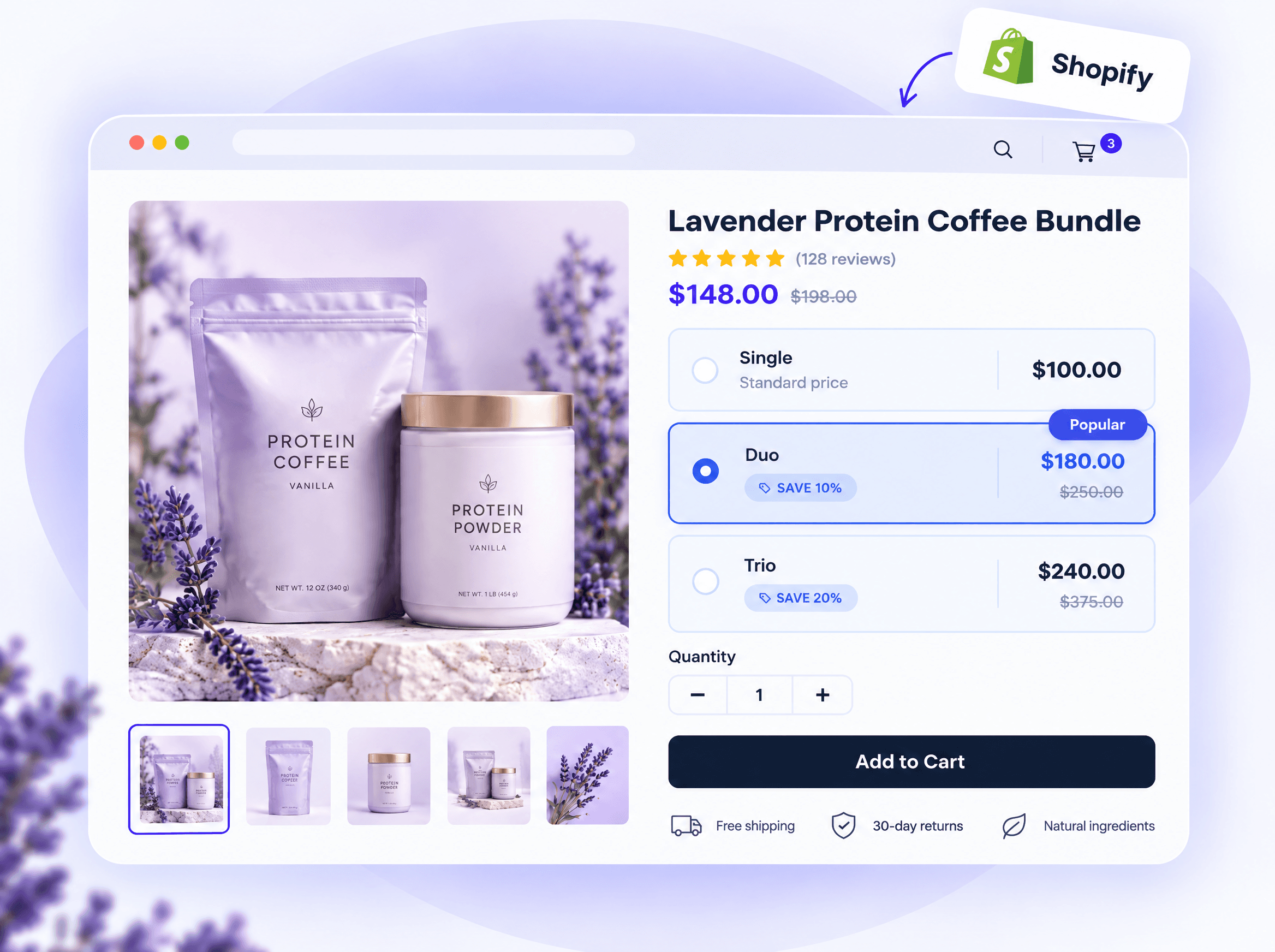
What matters more than picking one over the other is making sure the offer's logic is visible where the customer makes the decision — on the product page itself, not buried until checkout. A customer who doesn't realize a second unit is discounted until the cart page has already made their add-to-cart decision without that information.
Whichever structure you choose, the depth of the discount still needs to clear your margin floor — see how to price product bundles without hurting margins for the framework. And if your catalog has real variety within a category, it's also worth reading about when mix & match bundles outperform a fixed set, since that's a third structure worth considering alongside BOGO and volume pricing.
Frequently Asked Questions
Can BOGO offers hurt perceived brand value? They can, if used too frequently or across premium categories where discounting signals lower quality. BOGO tends to work best as a targeted, occasional tactic rather than a constant storewide fixture.
Do volume discounts work for one-time-purchase products? Less reliably. Volume discounts lean on the idea that customers will use more of something over time, which is a weaker argument for a one-time purchase like a piece of furniture. BOGO or a fixed bundle tends to fit one-time-purchase categories better.
Should the discount percentage be the same for BOGO and volume offers? No — they're calculated differently. BOGO discount depth is typically expressed as a percentage off the second item (up to 100% for a true "free"), while volume discounts are usually expressed as a percentage off the combined order. Compare them by their effect on overall order margin, not by the headline percentage.
How do I know if an offer is actually increasing revenue, not just shifting it? Track incremental units per order and total order value against a control period without the offer live, not just the conversion rate on the offer itself. An offer that increases order size without meaningfully improving overall revenue per visitor may just be shifting purchases forward in time rather than adding net new demand.
Ready to set up bundles on your own store?
Install CMX Bundles